Discovering efficient self-watering pots for busy people saved my indoor garden after I killed three succulents in a row. Three. Succulents, widely described as the houseplant you cannot kill. After the third one, I stopped blaming myself and started looking at the actual problem: I was watering inconsistently, either too much or too little, with no reliable way to know which. Self-watering pots solved this so completely that I now use them for almost everything.
If you travel for work, forget things frequently, or simply have too much going on to develop a reliable watering routine, this is the most practical plant-related investment you can make.
How Self-Watering Pots Work
A self-watering pot has two chambers: an upper chamber for soil and the plant, and a lower reservoir for water. A wicking system, either a rope, the soil itself, or a specialised insert, draws water upward from the reservoir into the soil as the plant needs it. The plant essentially regulates its own watering.
You fill the reservoir every 1–3 weeks depending on the plant, pot size, and season. That’s the entire maintenance requirement.
The Benefits Beyond Convenience
Self-watering pots don’t just save time, they produce healthier plants. Consistent moisture prevents the stress cycle of occasional heavy watering followed by drought. Roots grow more evenly. Overwatering becomes nearly impossible because the plant draws only what it needs, when it needs it.
This was the part that surprised me most. My plants didn’t just survive, they actually did better.
There is also a quieter benefit: self-watering pots make it far easier to leave plants with a neighbour or go away for a week without writing out watering instructions. A full reservoir before you leave is usually enough cover for most trips, which removes one more small source of pre-holiday stress.
What to Look for When Buying
- Reservoir capacity — larger reservoirs mean less frequent refilling; aim for at least 500ml for medium-sized plants
- Overflow hole — essential to prevent the reservoir overfilling and drowning roots during rainy spells on a balcony
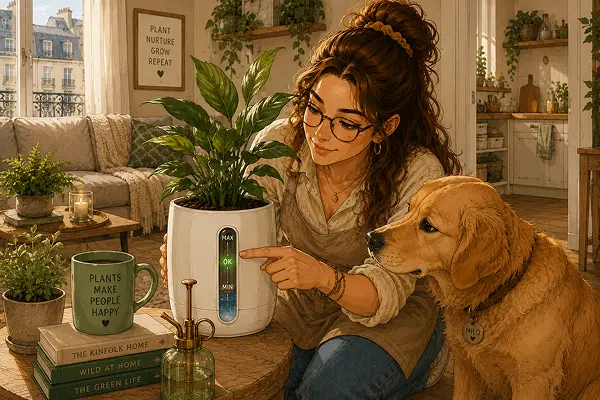
- Water level indicator — a visible indicator removes all guesswork
- Pot size — match to your plant’s root system; too large and the wicking mechanism becomes less effective
- Material — glazed ceramic and quality plastic both work well; avoid very cheap plastic that degrades within a year
Recommendations by Plant Size
For small herbs and plants
Compact self-watering herb pots in sets of three or four are ideal for kitchen windowsills. Look for designs with individual reservoirs rather than shared troughs, each plant then controls its own intake. I use a simple set from a garden centre that has been running without issue for two years.
For medium houseplants
The Lechuza Classico range is consistently well-reviewed, well-made, with a generous reservoir and clean minimal design that works in most interiors. More expensive than basic options but noticeably better quality and genuinely long-lasting.
For larger floor plants
For monsteras, fiddle leaf figs, or other statement plants, look for planters with reservoirs of 2 litres or more. IKEA’s SJÄLVVATTNING range offers good value for larger plants and fits well in the minimalist aesthetic common in small apartments.
What Self-Watering Pots Cannot Fix
- Wrong light conditions — no pot system helps a sun-loving plant in a dark corner
- Wrong plant for the environment — succulents and cacti prefer completely dry periods and generally don’t suit self-watering pots
- Complete neglect — plants still need occasional fertilising, repotting, and pest checks
Setting One Up for the First Time
The first fill matters more than people expect. Add water to the reservoir until it reaches the overflow hole, then plant as normal in the upper chamber using a standard potting mix, no need for anything specialised. Give the wicking system two or three days to establish before judging whether the soil feels right, it takes a little time for moisture to travel evenly upward.
A mistake I made early on was assuming a full reservoir meant I was done for weeks. Check it every few days at first, until you learn how fast a particular plant and pot combination actually drinks. Some plants, especially larger leafy ones in warm rooms, empty a reservoir in under a week. Others stretch closer to three.
If the soil surface looks consistently dry while the reservoir is full, the wick may not be seated properly, gently push it further into the soil chamber and check again in a day.
The Freedom to Be Inconsistent
Self-watering pots won’t replace all plant care, but they remove the most common cause of death: irregular watering. For busy people in small apartments, they make having plants genuinely sustainable, something you can maintain through a hectic week, a short trip, or simply a period where other things take priority.
Invest in a few good ones. Your plants will reward you, even during the weeks when you barely think about them.
For more on this, see Compact Composting Solutions for Small Apartments Without a Garden.
About Olivia
Olivia is passionate about small-space living, indoor gardening, sustainable home decor, and practical ideas that help people create beautiful and comfortable homes.