
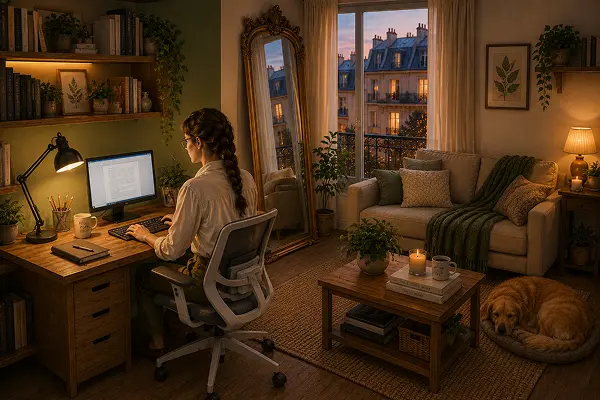
Learning how to build a home office that separates work and rest in one room is the ultimate layout challenge for modern remote workers. It is the subtle, slow way the invisible boundaries between professional productivity and personal rest completely erode until you find yourself never fully working and never fully resting. I spent eight exhausting months living in a tight urban layout where my wooden workspace desk was positioned barely three metres from my bed before I understood this environmental psychology properly. It took me another two months of rigorous, practical experimentation to create a structural separation that made both deep focus and restorative rest feel genuinely different.
Creating distinct visual and spatial zoning within a single, shared room addresses this psychological bleed at the environmental level, rather than forcing you to rely on exhausting mental willpower alone. Here is how to strategically design a healthy, clear separation in a multi-purpose urban space.
Why Environmental Zoning Matters for Mental Clarity
The human brain is a highly sophisticated pattern-recognition machine that naturally associates specific physical environments with internal neurological states. A traditional corporate office layout automatically triggers an active work state; a dedicated bedroom space triggers a calm, low-energy rest state. When these two opposing environments are compressed into the exact same four walls, the brain struggles to fully commit to either mode.
This spatial confusion is precisely why working from a laptop on your bed often feels less focused, and why attempting to sleep next to an active, cluttered desk feels less restorative. According to medical data published in the Sleep Foundation behavioral health index, clear visual boundaries between active zones and sleep environments are fundamental for reducing insomnia and modern work-related stress.
Strategies That Create Genuine Spatial Separation
To fix a shared-use room layout without breaking your budget, you must implement strict visual, lighting, and behavioral boundaries.

Smart room dividers and physical barriers
A tall open-backed bookshelf, a lightweight folding screen, a minimal curtain hanging on a ceiling-mounted metal track, or even a strategic cluster of large indoor plants can establish an immediate physical boundary between your active workspace and your bedroom zone. The barrier does not need to block the entire room; even a partial, temporary visual block drastically reduces the cognitive interference between the two spaces.
Distinct and targeted lighting schemes
Lighting is one of the most immediate and powerful environmental cues available to human biology. To train your brain to shift psychological modes instantly, you must install two entirely separate lighting schemes. For working hours, utilize a high-quality daylight desk lamp emitting bright, cool-toned, task-focused light to mimic natural sunlight. When evening arrives, switch off the desk setup completely and activate warm, dim, ambient bedside lamps. This strict division aligns your circadian rhythm, a practice strongly recommended in the HSE remote work workspace guidelines for protecting home worker well-being.
Dedicated equipment storage and closure
Leaving screens, paperwork, and open laptops visible from your resting position maintains a low-level, subconscious work activation in your mind even during your private downtime. A laptop that is physically closed and tucked into a drawer, a clean desk tidy that conceals cables, or a simple decorative cabinet door that closes over the monitor creates a sense of tactile finality. If you need inspiration on how to build clean, hidden storage elements using sustainable materials, see our comprehensive tutorial on how to Assemble a Sustainable Capsule Kitchen Using Only Natural Materials.
Tactical Desk Placement Decisions
If the structural dimensions of your room allow any flexibility regarding furniture placement, the golden rule of home office design is simple: position your desk so that it is completely hidden from your sleeping position. The psychological ability to see your active workspace, unread files, or corporate monitors from your bed is one of the most reliable disruptors of deep sleep quality for remote employees.
If your room shape makes this ideal layout impossible, ensure your desk faces completely away from the bed during the day, and place a temporary partition screen between the two zones at night. Furthermore, investing in highly supportive, industrial-grade seating that blends into a home environment is essential for long-term health. For our full, field-tested list of budget-friendly seating options, you can review our guide on the top Affordable Ergonomic Chairs for Remote Workers Under 300 Euros.
Accepting and Refining the Compact Space
A small city rental apartment or studio setup will never perfectly replicate the absolute psychological disconnect of a physical outdoor commute and a separate corporate building. However, your goal as an urban dweller is not total design perfection, but rather meaningful, daily improvements. By structuring your lighting, choosing smart furniture placement, and committing to clear separation rituals, you ensure that your work feels productive and your rest feels truly restorative.
About Olivia
Olivia Knows Things is the editorial voice behind this blog, created to share practical, tested ideas that help people create beautiful, comfortable, and sustainable homes.