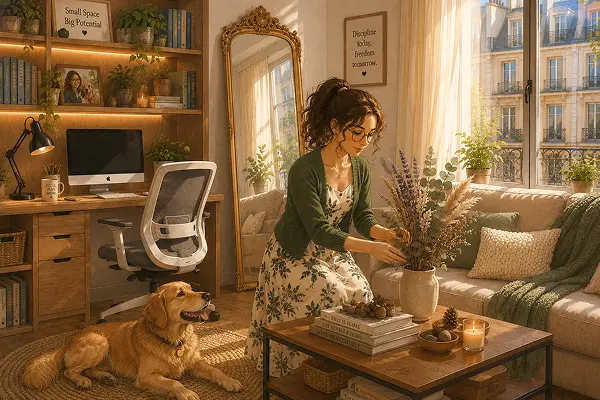
Learning how to use dried flowers and natural elements became my passion after I started drying flowers by accident when I forgot to throw away a bunch of peonies. Two weeks later, they were hanging upside down from a hook in the kitchen, slightly shrunken, papery, and honestly more beautiful than they’d been fresh. I’ve been drying flowers deliberately ever since.
Dried botanicals and natural elements are one of the easiest ways to add texture, warmth, and a quietly organic quality to a modern home — without the upkeep of fresh flowers and without the visual coldness of purely synthetic decor.
Why Dried Botanicals Work So Well in Modern Interiors
Modern interior design tends toward clean lines, neutral colours, and minimal clutter. Dried botanicals complement this aesthetic naturally — their muted tones (dusty pinks, warm creams, faded greens) sit beautifully against white walls and natural wood tones. They add the organic quality that purely modern rooms can lack without introducing the visual complexity of pattern or bright colour.
How to Dry Flowers at Home
The hanging method
The simplest and most reliable approach. Tie stems in small bunches, remove excess leaves, and hang upside down in a warm, dry, well-ventilated spot away from direct sunlight. Most flowers dry completely in 2–3 weeks. Direct sunlight bleaches colours quickly — a cool, dark room preserves them far better.
The vase method
Simply place stems in a vase with a small amount of water — just 2–3 cm — and let the water evaporate naturally. This works particularly well for grasses, alliums, and some roses. The flowers dry in place and can be displayed in the same vase.
The silica gel method
For preserving shape and colour more precisely, burying flowers in a container of silica gel crystals for 1–2 weeks draws moisture out efficiently. More involved than hanging, but produces more detailed results for delicate flowers like dahlias or garden roses.
Ideal Flowers and Plants for Drying
- Pampas grass — dramatic, architectural, works in almost any modern interior
- Lavender — dries beautifully, retains scent for months, perfect in bunches
- Eucalyptus — holds its colour and scent exceptionally well, versatile in arrangements
- Statice (sea lavender) — retains colour brilliantly, excellent as a filler in arrangements
- Roses — the classic; dry slowly for best results, retain colour well in a cool dark room
- Alliums — the round seed heads dry with perfect geometry and look beautiful individually
Beyond Flowers: Other Natural Elements Worth Incorporating
Branches and twigs
A single branch with interesting form — a curving birch, a spray of bare willow, a branch with lichen — in a tall vase creates a sculptural focal point that costs nothing and lasts indefinitely.
Stones and shells
A bowl of smooth river stones, a collection of shells from a beach, or a single interesting piece of quartz on a shelf adds a grounding, mineral quality to a room. These objects carry the memory of where they came from.
Pine cones, seed pods, and bark
Collected on walks and arranged in a bowl or along a shelf, these elements bring the texture of the forest indoors. They’re seasonal in a gentle way and can be changed or added to throughout the year.
Displaying Natural Elements in a Modern Home
The key to making natural elements look intentional rather than rustic is editing and placement. A single large bunch of pampas grass in a minimalist ceramic vase reads as contemporary. Twenty different dried flower arrangements clustered together reads as a different aesthetic entirely. Choose a few things, give them space, and let them be seen.
Keeping Dried Arrangements Looking Their Best
Dried botanicals last a long time, but not forever, and a little maintenance keeps them looking intentional rather than tired. Dust is the main enemy, it settles into the texture of dried flowers in a way it doesn’t on smooth surfaces, and a build-up dulls the colour and softness that made them appealing in the first place. A gentle shake outdoors, or a light pass with a soft makeup brush or hairdryer on the coolest, lowest setting, removes most dust without damaging brittle stems.
Direct sunlight continues to fade dried arrangements even after the drying process is complete, so a display near a bright window will lose colour faster than one in indirect light. If a piece has faded significantly and started shedding petals or leaves, that’s usually the sign it’s reached the end of its life rather than something to preserve further, and it’s a good moment to compost it and start a fresh arrangement rather than propping up something past its point.
Most dried arrangements hold their best appearance for six months to a year, depending on the flower and light exposure, after that, refreshing a display isn’t wasteful, it’s part of the natural rhythm of decorating with things that were alive. Rotating a few new dried pieces in seasonally also keeps a home feeling current rather than static.
The Quiet Beauty of Things That Age
What I love most about dried botanicals is that they change over time. Colours soften. Textures develop. A bunch of lavender that was vivid purple in summer becomes a muted silver-grey by winter — and it’s beautiful at every stage.
Find something to dry this week. You probably already have it in a vase.
For more on this, see Style a Cozy Reading Nook With Sustainable and Vintage Finds.
About Olivia
Olivia Knows Things is the editorial voice behind this blog, created to share practical, tested ideas that help people create beautiful, comfortable, and sustainable homes.