
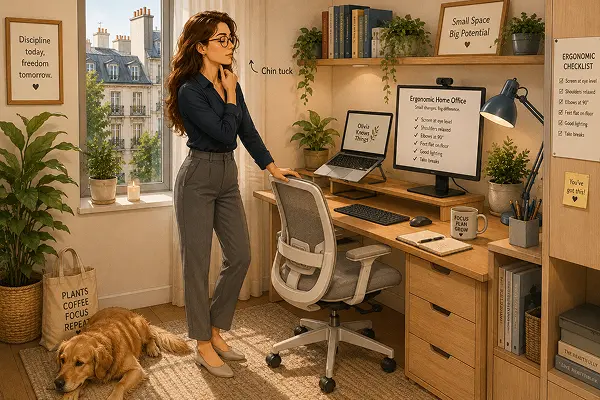
Learning how to reduce neck and back pain became essential when the postural discomfort usually started subtly as a slight stiffness at the end of the day. Shoulders that feel tighter on Fridays than Mondays. A neck that aches when you turn it too quickly. I ignored these signals for months, assuming they were just part of the deal of working from home. They’re not.
Neck and back pain from home working is almost always caused by a combination of poor posture, inadequate equipment, and insufficient movement, and almost all of it is preventable.
Understanding Where the Pain Is Coming From
Before fixing anything, it helps to understand the mechanism. Most work-from-home pain falls into one of three categories:
- Forward head posture — the head drifts forward of the shoulders as you lean toward a screen, placing enormous strain on the neck and upper back
- Rounded shoulders — arms reaching forward to a keyboard that’s too far away pull the shoulders forward and compress the upper back
- Loss of lumbar curve — slumping in a chair that doesn’t support the lower back flattens the natural curve of the spine over time
Structural Setup Changes for Better Posture
Raise your screen
This is the single most impactful change most remote workers can make. The top of your screen should be at roughly eye level, so your gaze falls naturally to the centre of the screen without tilting your head down. A laptop on a desk is almost always too low. A monitor stand, laptop riser, or even a stack of books solves this immediately and costs nothing.
Move your keyboard closer
Your keyboard should be close enough that your upper arms hang naturally at your sides, not reaching forward. If your keyboard is too far away, your shoulders pull forward automatically to compensate. Slide it closer. If you’re using a laptop raised on a stand, a separate external keyboard is essential.
Support your lumbar curve
Your lower back should maintain its natural inward curve while seated. If your chair doesn’t support this, a small lumbar cushion (10–20 euros) placed at the curve of your lower back makes an immediate difference. This isn’t a long-term fix, a proper ergonomic chair is, but it’s an affordable starting point.
Check your feet
Your feet should rest flat on the floor, with your hips at or slightly above knee height. Feet dangling or perched on tiptoe creates tension throughout the entire lower body that travels up the spine. A footrest (or a stack of books) costs almost nothing and solves this completely.
The Movement Question
No ergonomic setup compensates for sitting completely still for eight hours. The human body is designed to move, and static postures, even good ones, become problematic over long periods.
What actually worked for me was setting a timer for every 45 minutes. When it goes off, I stand up, walk to another room, do 30 seconds of neck rolls and shoulder circles, and come back. That’s it. Unglamorous, effective, and free.
Building the Movement Habit So It Actually Sticks
The timer method works, but only if it survives contact with a busy day. The most common way people abandon it is dismissing the alarm “just this once” during a focused task, which quietly becomes twice, then not at all within a week. It helps to treat the alarm as non-negotiable for the first month, even if you only manage 10 seconds of movement before sitting back down, consistency matters more than duration while the habit is forming.
Pairing the movement with something you’re already doing removes the friction of remembering. Standing up during the natural pause after finishing an email, or right before a scheduled call starts, uses an existing transition point in your day rather than asking you to notice an arbitrary alarm and interrupt deep focus.
It’s also worth accepting that some days won’t go to plan. A day full of back-to-back meetings might mean fewer movement breaks than usual, and that’s a normal fluctuation, not a failure of the system. What matters over weeks is the general pattern, not a perfect daily record.
Simple movements for desk workers:
- Chin tucks — draw your chin straight back, creating a ‘double chin’. Holds the head in neutral position and counteracts forward head posture
- Shoulder rolls — backward, slow, deliberate. Do ten every hour
- Chest opener — clasp your hands behind your back and gently open the chest. Hold for 20 seconds
- Hip flexor stretch — kneel on one knee, shift forward gently. Counteracts the hip flexor tightening that comes from prolonged sitting
When to See a Professional
If pain is persistent, wakes you at night, radiates down your arms or legs, or came on suddenly rather than gradually, see a doctor or physiotherapist. Setup changes help with postural discomfort; they don’t address nerve compression, disc issues, or other structural problems that need professional assessment.
Pain Is Feedback, Not Inevitability
Working from home shouldn’t hurt. The discomfort that many remote workers accept as normal is the body signalling that something needs to change, and most of the time, the changes are simpler and cheaper than people expect.
Start with your screen height. Fix that first. Then work through the rest. Your body will tell you what’s working.
This article is for informational purposes only and does not replace professional medical advice. If you’re experiencing persistent pain, please consult a physiotherapist or doctor.
About Olivia
Olivia Knows Things is the editorial voice behind this blog, created to share practical, tested ideas that help people create beautiful, comfortable, and sustainable homes.