Finding efficient low-light indoor plants becomes a survival skill if you live in a northern European city and already know the light situation. Grey skies from October to March, narrow streets that swallow what little sun exists, and apartment windows that face courtyards or brick walls. I spent three winters in Amsterdam convinced that houseplants simply weren’t for people like me, until I discovered there’s an entire category of plants that evolved specifically for low-light conditions.
These aren’t consolation prizes. Some of them are genuinely beautiful. And almost all of them thrive on neglect.
What “Low Light” Actually Means And What It Doesn’t
Low light doesn’t mean no light. It means indirect, diffused light, the kind that comes through a north-facing window or filters in from an adjacent room. Even the most shade-tolerant plants need some ambient light to survive. What they don’t need is direct sun.
In practice, this means most rooms in a European apartment are workable, you just need the right plants.
Courtyard-facing and ground-floor apartments deserve a specific mention here, since they often combine low light with reflected light bouncing off neighbouring buildings, which can actually be brighter than a simple north-facing window despite feeling darker to the eye. If your apartment falls into this category, it’s worth observing the space for a few days before assuming it’s too dark for anything beyond the most extreme low-light plants.
The Plants That Genuinely Thrive in Dark Northern Apartments
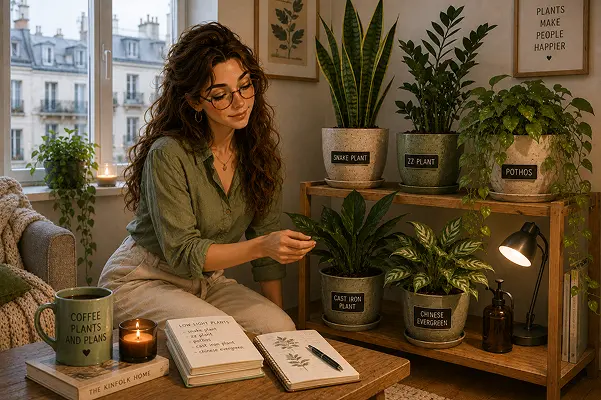
Sansevieria, Snake Plant
The undisputed champion of low-light survival. I’ve had a snake plant in a corner that receives virtually no natural light for two years. It has not only survived, it’s grown three new leaves. Water it every 2–3 weeks in winter, less if the soil still feels damp. It genuinely prefers being left alone.
ZZ Plant (Zamioculcas zamiifolia)
The ZZ plant stores water in underground rhizomes, making it extraordinarily drought-tolerant. It grows slowly, stays compact, and handles near-darkness with dignity. Its deep green waxy leaves look polished and intentional, the kind of plant that makes a room look curated rather than abandoned.
Pothos (Epipremnum aureum)
Fast-growing, trailing, and incredibly adaptable. Pothos adjusts to almost any light condition, from dim corners to bright indirect light. Let it trail from a shelf or train it up a small trellis, either way, it fills a space beautifully and grows quickly enough to feel rewarding.
Cast Iron Plant (Aspidistra elatior)
The name is not an exaggeration. Cast iron plants were the go-to houseplant in Victorian England, dark, smoky rooms with minimal air circulation and they handled it fine. They grow slowly, ask for almost nothing, and last for decades. If you want a plant that will outlive several rearrangements of your apartment, this is it.
Chinese Evergreen (Aglaonema)
One of the most adaptable houseplants available. Chinese evergreens come in a wide range of leaf colours: deep green, silver, pink, red and handle low light, better than almost any other decorative plant. They’re my recommendation for anyone who has killed everything else and is ready to try once more.
Small Things That Make a Real Difference
Even the toughest plants benefit from a little attention. These habits take minutes and make a noticeable difference:
- Dust the leaves monthly — dust blocks light absorption, even in low-light plants
- Rotate the pot every few weeks so growth stays balanced and even
- Use pots with drainage holes and well-draining soil — root rot is the primary killer in dark, slow-drying conditions
- Keep plants away from cold windows in winter — cold glass can damage tropical species overnight
A Note on Soil in Dark Apartments
In low-light rooms, soil stays wet far longer because there’s less evaporation. This makes drainage critical. Add perlite (small white volcanic particles, available at any garden centre) to your potting mix, roughly 30% perlite to 70% soil, to improve drainage significantly. Terracotta pots help too; they breathe better than plastic and reduce the risk of overwatering.
Signs a “Low-Light” Plant Still Isn’t Getting Enough
Even the toughest low-light plants have a floor. If a snake plant or ZZ plant sits in a genuinely windowless space, or a room lit only by artificial light during the day, growth will eventually stall completely rather than just slow down, and leaves can start to look thin or pale rather than firm and glossy. That’s the point where even the most forgiving species needs help.
A small LED grow light on a timer solves this without changing the character of the room. A few hours a day, positioned reasonably close to the plant, is usually enough to keep a snake plant or pothos ticking over in a space with no natural light at all. It’s a small addition, but it’s often the difference between a plant merely surviving and one that actually grows.
It’s also worth distinguishing dormancy from decline. Many of these plants slow down naturally over the darkest months, October to February, and that’s normal, not a warning sign. What matters is whether a plant picks back up once the days lengthen in spring. If it doesn’t, the light in that spot is likely too low even for these hardy species.
Where to Begin
Start with a snake plant and a pothos. Together they cost less than a dinner out, they’ll survive almost anything, and they look good doing it. From there, add a ZZ plant when you’re ready for something slower and more architectural.
A dark apartment isn’t a plantless apartment. It’s an apartment that needs a different kind of plant, and once you find the right ones, you’ll wonder why you waited so long.
About Olivia
Olivia Knows Things is the editorial voice behind this blog, created to share practical, tested ideas that help people create beautiful, comfortable, and sustainable homes.