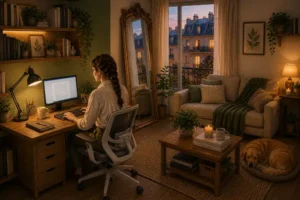
Learning how to improve natural light in your home office became my priority when I realized my workspace faces east and the morning sun streams in for only a limited time. In practice, by 10am the sun had moved, the room was dim, and I was squinting at my screen with a headache building. Natural light in a home office isn’t just about comfort. It directly affects focus, mood, and eye strain, and most people are working in far less of it than they realise.
Here’s how to significantly improve the natural light in your workspace without touching a wall.
Start by Understanding What You Actually Have
Before changing anything, spend a few days observing how light moves through your workspace. When is it brightest? When does it dip? Where does direct sun fall, and does it create glare on your screen? This 10-minute observation will tell you more than any guide, because every room behaves differently depending on orientation, surrounding buildings, and window size.
It’s worth doing this observation more than once, ideally in different seasons if your schedule allows, since a room that feels perfectly lit in June can feel noticeably different by November as the sun’s angle and daylight hours shift.
High-Impact Layout Changes for Better Light
Clean the windows
Genuinely the most overlooked improvement. Dirty windows can reduce light transmission by 20–30%. Clean both sides if you can, and clean the window frames while you’re at it. It takes 10 minutes and the difference is often remarkable.
Change your window treatments
Heavy curtains, dark blinds, or net curtains that you leave half-drawn are often blocking far more light than you realise. Replace dark curtains with sheer white or neutral ones, they provide privacy while allowing a significant amount of light through. Roller blinds in a light-filtering (not blackout) fabric are another excellent option.
Use mirrors strategically
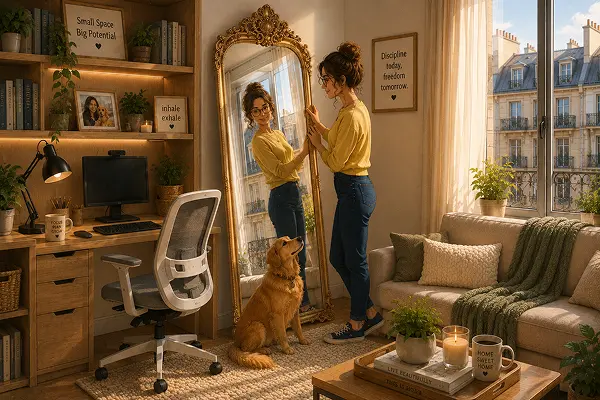
A large mirror placed opposite or at an angle to your window can effectively double the perceived natural light in a room by bouncing it further inward. I added a full-length mirror to the wall opposite my east-facing window and the change was immediately noticeable, the back half of the room, previously always dim, became usably bright.
Lighten the walls and surfaces
Dark walls and furniture absorb light; light ones reflect it. If you’re not in a position to repaint, you can still make a difference by adding lighter accessories, a white desk mat, lighter shelving contents, removing dark objects from surfaces near the window. Every reflective surface helps.
Rearrange your desk position
Sometimes the simplest solution is moving the desk. Position yourself so the window is to your side (not directly in front, which creates glare, or directly behind, which creates shadow on your work surface). Even a 45-degree shift in desk position can change the quality of light you’re working in dramatically.
When Natural Light Isn’t Enough: Supplementing Smartly
In northern European climates, or in rooms with limited window access, supplementing with artificial light is necessary for much of the year. The key is getting the colour temperature right.
- Daylight bulbs (5000–6500K) mimic natural daylight and support alertness and focus
- Warm bulbs (2700–3000K) are relaxing — excellent for evenings, but not for daytime work
- A quality desk lamp with adjustable colour temperature gives you flexibility across the day
- A light therapy lamp (10,000 lux) on your desk during dark winter months makes a noticeable difference to energy levels and mood
Seasonal Adjustments Worth Making
Light changes more dramatically through the year than most people account for when setting up a workspace once and leaving it. In autumn and winter, the sun sits lower in the sky, which can mean more direct glare through a window that felt perfectly diffuse in summer, worth reassessing your desk angle seasonally rather than assuming spring’s arrangement still works in December.
Artificial light needs also shift. A desk lamp that felt like an occasional backup in June often becomes essential by November, when natural daylight hours shrink significantly in northern Europe. Rather than waiting until the room feels noticeably dim to react, it’s worth building the desk lamp into your daily routine from autumn onward as a default, not a last resort.
Mirror placement can also lose effectiveness as the sun’s path shifts. A mirror bouncing useful light into the room in July might be bouncing very little by January, if this happens, it’s worth experimenting with angle adjustments a couple of times a year rather than assuming the original placement is permanently optimal.
The Light You Work In Shapes How You Work
Poor lighting is one of those background stressors that most people don’t identify correctly. The fatigue, the eye strain, the low-grade headaches, they feel like work stress or screen time, but they’re often simply inadequate light.
Fix the windows first. Move the mirror. Change the blind. These are afternoon projects with lasting returns.
About Olivia
Olivia Knows Things is the editorial voice behind this blog, created to share practical, tested ideas that help people create beautiful, comfortable, and sustainable homes.