
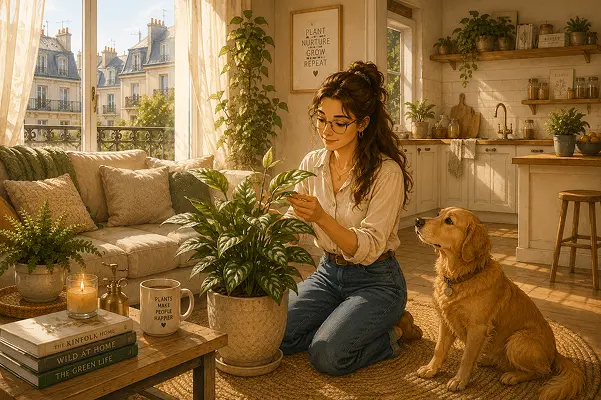
Bringing home a thriving fiddle leaf fig or a blooming peace lily only to watch it drop its leaves six weeks later is a familiar frustration in north-facing apartments. Standard plant labels promising “bright indirect light” rarely prepare you for a window that never receives a single direct sunbeam. Choosing indoor plants for a north-facing window works much better when you match shade-adapted species to cool, steady daylight and adjust watering for slower evaporation.
What a North-Facing Window Actually Provides
In the Northern Hemisphere, a north-facing window delivers gentle, diffused daylight without harsh midday rays. While summer afternoons can feel reasonably bright, winter daylight drops sharply, especially in northern and central European cities with overcast skies and short days.
Regional latitude also shifts what is possible. A north-facing room in southern Europe, such as Lisbon or Madrid, receives noticeably stronger ambient light than the same exposure in Amsterdam, Berlin, or Warsaw. Treating species recommendations as a starting point and observing how each plant responds on your specific windowsill prevents frustration.
Plants That Genuinely Thrive Facing North
According to indoor gardening guidance from the Royal Horticultural Society (RHS), shade-tolerant houseplants evolved beneath dense forest canopies where sunlight filters softly through leaves rather than hitting directly.
Aspidistra (Cast Iron Plant)
Few houseplants tolerate deep shade as reliably as Aspidistra elatior. In Victorian parlors—which were notoriously dark, poorly ventilated, and heated by smoky coal fires—aspidistras routinely survived for decades while fussier plants withered within months. Today, they remain ideal for dim apartment corners, growing slowly and tolerating cool drafts and infrequent watering without dropping foliage.
Dracaena
Varieties such as Dracaena marginata and Dracaena fragrans adapt comfortably to north-facing rooms while adding vertical structure in narrow spaces. They prefer their topsoil to dry out halfway between waterings and typically need water only every 10 to 14 days, making them forgiving if you occasionally miss a watering day.
Chinese Evergreen (Aglaonema)
For someone starting over after losing a couple of finicky tropical plants on a dim windowsill, a deep-green Aglaonema is one of the most forgiving reset choices. Dark-green and silver-patterned cultivars handle low natural light better than almost any other decorative foliage plant. (Variegated pink or red cultivars need brighter light to keep their color, so stick to deep-green varieties for north exposures.)
Bird’s Nest Fern (Asplenium nidus)
Unlike desert plants, forest-floor ferns thrive in cooler, diffused light. The bird’s nest fern brings sculptural, wavy fronds to a windowsill or bathroom shelf and appreciates moderate indoor humidity rather than dry radiator heat.
Heartleaf Philodendron (Philodendron hederaceum)
This trailing vine adapts smoothly to north-facing shelves and windowsills, producing steady new growth even without direct sun. Letting it cascade from a high shelf or climb a small moss pole adds lush greenery without taking up valuable floor space.
For additional shade-resilient options suited to compact Nordic and central European flats, explore our guide on low-light indoor plants for small dark apartments in Northern Europe.
Adjust Watering and Soil for Low-Light Conditions
In a north-facing apartment, overwatering, not darkness, is the most common reason plants fail. A pot that dries out in five days on a sunny south-facing sill can easily stay soggy for three weeks by a cool north window, which is why sticking to a rigid “water every Sunday” habit often leads to yellow leaves and root rot.
- Use fast-draining potting soil: Mix roughly 30% perlite or coarse bark into standard indoor potting soil so air reaches the roots between waterings.
- Choose breathable containers: Unglazed terracotta pots allow excess moisture to wick through the walls, reducing the risk of root rot in cool rooms.
- Check soil depth, not the calendar: Push a finger at least 3 to 4 centimetres into the soil before watering. If the lower layer still feels cool and damp, wait several more days.
- Pause fertilizer in autumn and winter: Plants grow slowly under low winter light and cannot use extra nutrients, which can build up as salts in the soil.
Simple Ways to Maximise the Light You Have
Small adjustments around the window noticeably increase the usable light reaching your plants:
- Clean window glass regularly: Dust and city film on exterior panes block a surprising share of weak winter daylight.
- Place plants right on the windowsill: Light intensity drops sharply with every metre away from the glass, so position north-facing plants within 50 centimetres of the window.
- Use pale walls and mirrors: Light-colored curtains, white window reveals, or a mirror placed opposite the window bounce ambient daylight deeper into the room.
- Supplement with a compact LED grow light: During the darkest winter months, running a full-spectrum LED grow light on a timer for 6 to 8 hours prevents leggy growth.
- Keep leaves dust-free: Wiping broad leaves with a damp cloth every few weeks helps foliage capture every available photon.
Signs Your North-Facing Plant Is Struggling
Learning to distinguish normal slow growth from light stress helps you intervene early:
- Normal behavior: Fewer new leaves between November and February, or an occasional oldest lower leaf yellowing and dropping naturally.
- Signs of insufficient light: New leaves emerging noticeably smaller than older ones, long bare gaps of stem stretching toward the glass, or persistently wet soil that takes more than three weeks to dry.
If you see stretching or stalled drying, move the pot directly onto the sill or add a small clip-on grow light until spring daylight returns.
Building a North-Facing Indoor Garden That Lasts
A north-facing apartment does not mean giving up on houseplants, it simply rewards choosing species built for gentle shade rather than full sun. Start with one resilient anchor plant like a cast iron plant or green Aglaonema, keep the potting mix airy, and water only when the soil genuinely dries out.
For more ideas on pairing low-light greenery with better indoor air quality, see our guide on air-purifying plants for a small bedroom with poor ventilation.
About Olivia
Olivia Knows Things shares practical, research-backed ideas for living well in small apartments and compact urban spaces. Every guide focuses on realistic, sustainable, and renter-friendly solutions for indoor gardening, ergonomic home offices, and conscious home decor.

Comments
Pingback: Fresh Herbs on a Small Apartment Windowsill: Low-Light Kitchen Guide