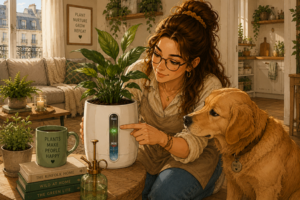
My bedroom has one window that faces a narrow internal courtyard. Opening it in summer means street noise and warm air from the building below. Keeping it closed means waking up with that particular stuffiness that comes from sleeping in a room that hasn’t breathed properly overnight. I started adding plants not primarily for aesthetics but out of genuine frustration with the air quality, and the difference, over several months, was noticeable.
Air-purifying plants are not a substitute for ventilation, but in a bedroom with limited airflow, they make a measurable contribution to the quality of the air you breathe while sleeping.
What Air-Purifying Plants Actually Do
Plants absorb carbon dioxide and release oxygen through photosynthesis, but their air-purifying properties go further than this basic exchange. NASA research in the late 1980s found that certain plants absorb volatile organic compounds (VOCs), chemicals released by furniture, paint, and synthetic materials that accumulate in poorly ventilated spaces.
The research has been contested since, with some scientists arguing that the effect in a real bedroom is smaller than lab conditions suggest. What remains true is that plants increase local humidity, reduce CO2 concentration, and absorb some airborne compounds. In a small bedroom with poor ventilation, these effects are worth having.
The Best Plants for a Small Poorly Ventilated Bedroom
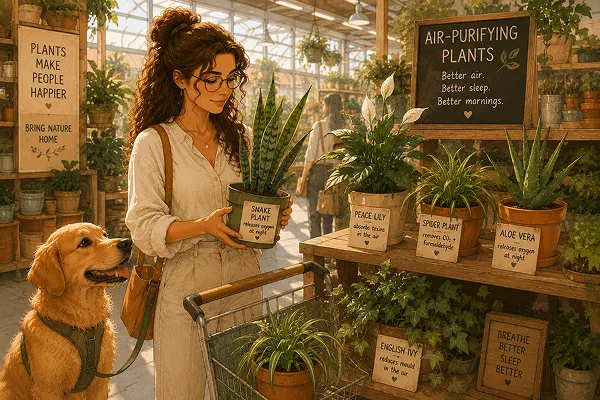
Snake Plant (Sansevieria)
The most recommended bedroom plant for good reason. Unlike most plants, snake plants continue releasing oxygen at night rather than switching to carbon dioxide absorption, making them particularly useful in sleeping spaces. They tolerate low light, need watering only every two to three weeks, and are nearly indestructible. One or two near the bed is the simplest possible starting point.
Peace Lily (Spathiphyllum)
Among the most effective plants at absorbing benzene, formaldehyde, and trichloroethylene, chemicals common in painted or furnished rooms. Peace lilies also transpire significantly, increasing humidity in dry bedroom air. They flower in low light, producing elegant white blooms, and will visibly droop when they need water, an extremely useful built-in indicator for a bedroom plant.
Spider Plant (Chlorophytum comosum)
Highly effective at absorbing carbon monoxide and formaldehyde, and completely safe for households with pets. Spider plants thrive in indirect light and tolerate considerable neglect. Their cascading habit makes them excellent in hanging positions near a window, keeping them off floor or surface space.
Aloe Vera
Like snake plants, aloe vera releases oxygen at night. It also absorbs benzene and formaldehyde, chemicals released by paint and cleaning products. Aloe needs good light but very little water, making it ideal on a bedroom windowsill that receives some indirect sun. Keep it in terracotta for best results.
English Ivy (Hedera helix)
Studies have found English ivy particularly effective at reducing airborne mould particles, which accumulate in poorly ventilated rooms and can affect sleep quality and respiratory health. It prefers cooler conditions and indirect light, both typical of north or east-facing bedrooms.
How Many Plants Do You Actually Need
The NASA study suggested approximately one plant per 9-10 square metres for meaningful air quality effects. For a small bedroom of 12-15 square metres, two to three plants of the varieties above will make a difference. More is not necessarily better, a small bedroom crowded with plants can feel oppressive rather than restful.
Placement for Maximum Effect
- Near the bed but not directly beside the head, you want the plant’s air exchange to affect the room without crowding your sleeping space
- Near the window for plants that need some light, and away from it for very low-light varieties like peace lily
- On a surface rather than the floor if space allows, air circulation is better and the plant is more visible
A Bedroom That Breathes a Little Better
The courtyard window is still limited. But the bedroom now has a snake plant on the dresser, a peace lily in the corner, and a spider plant trailing from a shelf above the window. The stuffiness that used to greet me in the morning has diminished, not disappeared entirely, but noticeably improved.
Start with a snake plant. Put it near your bed. See how the room feels after a few weeks.
About Olivia
Olivia is passionate about small-space living, indoor gardening, sustainable home decor, and practical ideas that help people create beautiful and comfortable homes.